
Birding is on the rise, but it’s not just retirees who are flocking to the hobby. A pursuit that dates back to ancient times is now gaining more young followers in Edmonton and abroad.
“If somebody asked me, ‘Who are you?’ The first thing I would say is that I’m a fan of birds and birds of prey,” said 15-year-old Rory Le, an avid birder from Edmonton.
Le first started getting interested in birding when she was in the third grade. Since she started keeping track of birds, she’s documented 81 species, but said she has probably seen at least half of the bird species around Edmonton.
Her favourites are birds of prey like American kestrels and ferruginous hawks. While she thinks their adaptations are particularly interesting, she also thinks they’re the cutest.
Last week, she was very excited when a falcon came to her front porch for a kill it had made earlier. She watched from just two feet away as it ate its dinner.
“I think interactions like that between humans and animals are really interesting,” she said. “Like you see peregrine falcons living Downtown, living on the skyscrapers. I think things like that are really cool.”
While she’s not yet sure how, her goal is to make birds a big part of her career.
Online platforms like Instagram and TikTok are well-populated with content about birding, and Gen Z now makes up a bulk of online birding influencers. Le said she’s noticed a lot more young people talking about the hobby online, while she’s active herself on some online birding forums as well.
Some online birders and influencers compare the hobby to Pokémon, while others have referred to it as the ultimate “hot-girl hobby.”
When Jan Wijmenga, 45, a University of Alberta field technician with the faculty of biological sciences and board member with the Edmonton Nature Club, hears that phrase, he can’t help but chuckle.
While he said it’s not all “hot-girls” in the community, he’s noticed more and more young people are picking up the hobby.
Originally from the Netherlands, Wijmenga was surprised when he came to North America 10 years ago and found that birding was a hobby enjoyed by “the stereotype senior white guy,” not a passion seen across all wider age groups like in his homeland and Western Europe.
“But that is, I think, slowly changing,” Wijmenga said, whose nature club works to get more people engaged with nature through walks within the city, and field trips, too.
Wijmenga also notes there is a slight difference between birdwatching and birding. Neither is a “right or wrong” way to engage with birds; however, birdwatching is the more relaxed form, while birding is associated more with “goal-oriented” enthusiasts.
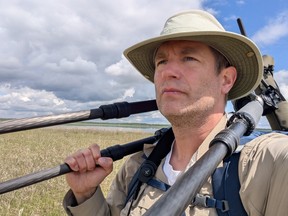
Birding 101
Even on a cool May morning, the boardwalk at Lois Hole Centennial Provincial Park in St. Albert is rife with birders, as Erin Dykstra, owner of Wild Birds Unlimited, and a group of several dozen people, from children with parents to young adults and senior citizens, trek slowly across the wooden walkway that cuts through the middle of the park’s grassy wetland.
Dykstra, owner and proprietor of Wild Birds Unlimited, a backyard bird-feeding store in Edmonton, is their guide. She usually runs multiple birding walks throughout the year. Ears attuned to the chanting chirps of red-winged black birds, warblers, and swallows, she latches onto each unique call, telling the group to keep watch and listen.
She pulls out the sound of a sora, a bird that lives in the marsh, but no one is able to spot it. It’s quite a secretive bird, Dykstra said.
“Birding starts with listening,” Dkystra said later in an interview.
As a birding newbie, the best thing to do is start listening for the sounds of the kinds of birds you see all the time, like chickadees, known for their iconic call. Get used to listening to the birds you know before launching into tracking down more novel winged wonders.
“Then when you hear something you’ve never heard before, it sticks out to you,” she said. One then naturally starts building a personal inventory of bird calls and matching species.
“That’s how you start birding. The more you do it, the better you get at it.”
Many people also have what birders call a “spark bird,” which Dykstra said is the first bird someone takes note of that gets them curious to learn more.
‘Everything is AI-generated’ but birding is authentic
Technology is both pushing newbies away from their screens and into nature, while also connecting birders and acting as a tool for birding. While influencers are one part of it, the introduction of birding apps, like Merlin Bird ID, and eBird, both developed by the Cornell Lab of Ornithology, are another. As of 2025, the Merlin app has more than ten million users worldwide.
Le said she first got interested in birding because she found a similar app that identified birds from users’ photographs.
“I thought it was really cool, so I started going outside, taking photos of different birds I saw, figuring out what they are, learning more about them.”
These apps can also trigger a great deal of excitement when an interesting species is spotted.
Last week, Wijmenga noticed an alert come up on eBird. He was working from home and immediately replanned his day because a rare bar-tailed godwit had been spotted at Hastings Lake, just east of Edmonton.
This was only the second time the bird had ever been seen in Alberta, with another sighting happening in 2022.
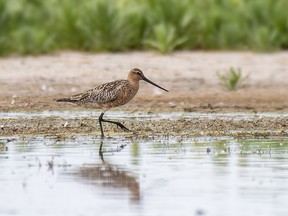
“I think there was a collective of a few 100 hours spent that day by a whole number of people, but nobody managed to re-find the bird,” Wijmenga said, noting that word of the rare bird spread quickly. He said another local birder, Sydney Mohr, was able to land an official sighting.
Wijmenga said many birders like to keep track of the species they spot, and some can even get pretty competitive. On eBird, he’s recorded a total of 657 species.
Dykstra, Wijmenga and Le are all birds of a feather, saying there are a lot of personal benefits to the hobby. Dykstra thinks young people are getting more interested because it helps them get away from the digital world and connect with nature.
“I mean, everything is AI-generated. And being out in nature and seeing birds, that is like something authentic,” she said.
And, she added, birding helps one to be more mindful, to pay more attention to the world around them and connect with it in a meaningful way. She said there’s a wealth of research pointing to mental health benefits and birding.
Wijmenga believes the pandemic might have also played a role. While many people were unable to connect directly with each other, more turned to nature.
“The use of technology is getting a lot more relevant,” said Le. “It’s creating an environment where people want to reconnect with nature more.”
Between the helpful birding platforms and viral internet popularity, there is some irony that even the hobby of birding remains entwined with technology.
But as Dykstra says, all you really need to get into birding is a curiosity about birds and the means to spot them, whether you’re in the city, in nature, or in your backyard.
Bookmark our website and support our journalism:Don’t miss the news you need to know — add EdmontonJournal.com and EdmontonSun.com to your bookmarks and
You can also support our journalism by becoming a digital subscriber. Subscribers gain unlimited access to The Edmonton Journal, Edmonton Sun, National Post and 13 other Canadian news sites. Support us by subscribing today: The Edmonton Journal | The Edmonton Sun.