
Posted October 21, 2026 2:45 pm.
A machine that can temporarily take over the work of a person’s heart and lungs has helped save more than 100 critically ill children at the Montreal Children’s Hospital over the past 35 years.
For Zoey Gauld and Adam Kinner, one of those children is their 17-month-old son, Noni Kinner-Gauld.
“It gave us Noni,” Gauld said. “He likely would not be here without ECMO. It means everything.”

Noni was just 18 hours old when dangerously low oxygen levels led doctors to turn to extracorporeal membrane oxygenation, or ECMO.
Gauld said Noni appeared well when he was born, but soon began struggling to breathe. He was suffering from meconium aspiration syndrome and was transferred to the Montreal Children’s Hospital, where doctors tried different forms of ventilation.
When those weren’t enough, his parents were told ECMO was likely the last intervention available that could save his life.
“It was incredibly difficult,” Gauld said. “We were sort of being told that there wasn’t a lot they could do for him.”
ECMO circulates a patient’s blood outside the body, adding oxygen and removing carbon dioxide before returning the blood. It can temporarily support the heart, lungs or both, giving the organs time to rest and recover.
“Essentially, it’s a pump,” said Dr. Joshua Feder, a pediatric critical care physician and medical director of extracorporeal life support at the Montreal Children’s Hospital.
“It pulls blood out of the body, it acts like the function of the lungs, so it gives it oxygen, takes away any waste products and then sends the blood right back into the body.”
Feder said ECMO is reserved for the most critically ill patients, including those experiencing severe lung or heart failure or, in some cases, patients receiving CPR.
The decision to use it comes when other options, including medication and mechanical ventilation, are no longer enough.
“The condition is the most critical, and there’s nothing else we can offer before ECMO,” Feder said.
For Noni’s parents, seeing their newborn connected to ECMO was overwhelming.
“There were these two very large cannulas coming out of his neck,” Kinner said. “And all these people around, but also just so many machines. It’s like a room full of machines.”
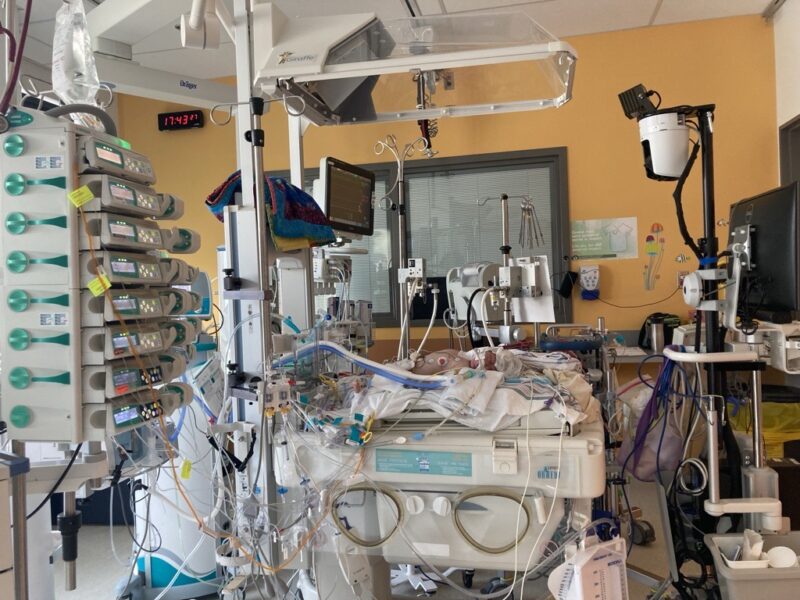
ECMO requires an extensive medical team to operate and monitor it around the clock.
Feder said placing a patient on ECMO can require an additional 10 to 15 people in the room, including surgeons and operating-room staff. Once the patient is connected, perfusionists, ECMO specialists, nurses, intensive-care physicians and other health-care professionals are involved in their care.
“The ECMO machine itself doesn’t function without the perfusionist and without the ECMO specialist,” Feder said.
Noni spent about 72 hours on ECMO and five weeks in hospital.
His parents say he has since made a full recovery. He is now in daycare and continues to be followed by specialists at the hospital.
“Every time we go, they’re like, ‘He’s doing the new thing. We have no problems,’” Gauld said. “He’s just bigger and taller than he’s supposed to be.”
Another family celebrating Wednesday knows that uncertainty well.
Neriah Johnstone was three years old when she contracted respiratory syncytial virus, or RSV, in 2021. Her condition deteriorated and she ultimately spent seven days on ECMO.
Her parents, Meagan Calder and Andrew Johnstone, said they were living moment to moment during their daughter’s illness.
“It was really scary,” Calder said. “We didn’t really understand it at first. We knew it was a really tough decision to make and it was going to be a huge surgery, but it wasn’t until after that we really understood the depth of the situation.”

Five years later, Neriah is eight years old, plays sports and does ballet.
“It allowed us to see our daughter,” Johnstone said. “That means a lot to us, and just spend our lives with her.”
The anniversary also reunited the family with Sheila Saldanha, a perfusionist at the McGill University Health Centre who Calder remembers as a reassuring presence throughout Neriah’s treatment.
“It was up and down some days, but with the perfusionist Sheila, she was very reassuring,” Calder said. “She helped us get through the whole process.”
A passionate perfusionist
Perfusionists play a critical role in ECMO care, monitoring the machine and making adjustments while it is supporting a patient.

For Saldanha, who has worked as a perfusionist for nearly 30 years, seeing former patients years after treating them can be emotional.
“We generally don’t realize at that moment what we do,” she said. “But when patients like this come back and they tell us, ‘I’m studying to be a teacher. I’ve just done my biomed undergrad,’ it really touches our soul and our heart.”
One of those former patients is 21-year-old Charbel Younis.
Younis needed ECMO shortly after he was born. More than two decades later, he returned to the hospital Wednesday to learn about the program and hear the experiences of other former patients.
Now studying biomedical sciences, Younis says he is considering becoming a perfusionist himself.
“From all the stories I heard about my story, about other people’s stories, of course I think it does have an influence on my choice,” he said.
Not without risk
Over the past 35 years, ECMO technology has become smaller and more advanced, but Feder said significant risks remain.
When a patient’s blood comes into contact with the artificial materials in an ECMO circuit, it can contribute to inflammation, clotting and bleeding. Feder said reducing those complications remains one of the major challenges in ECMO medicine.
Modern circuits are smaller and use specialized coatings designed to reduce those effects, he said.
But for the families and medical professionals gathered Wednesday, the anniversary was also an opportunity to see what those years of highly specialized care have made possible.
“What I saw today has given me the energy, the boost to continue doing what I was so passionate about,” she said.
